Posts

2026 Resume Basics Update: Part 1

Image
  While the standard format of resumes hasn’t changed extensively, many subtleties have due to the increased use of application tracking software (ATS) and artificial intelligence (AI) in recruiting departments. These tools have changed how resumes are filtered and sorted, often eliminating applicants before they appear before a recruiter. It is important to recognize that this article focuses on resumes, not CVs . CVs are intended to present the entire career path, and often include publications, all awards and commendations, volunteer work, and educational coursework. Resumes are summaries of work experience, usually no more than the past 10 years of relevant experience while using your skills section to highlight the full breadth of your relevant achievements. I have divided this into three parts. The first part outlines what categories must be included on your resume. I summarize what should be included in the section and briefly touch on basic formatting. In the second part, I...

Resume Series: The Basics

Image
Note: This article was originally published December 12, 2020 on my now-defunct website for AMA Creative Solutions. I have completed the most minor of edits, so what you see is what was published (barring a glaring and obnoxious error). There are many, many ways to organize a resume. Looking at resume samples and advice can be overwhelming and the advice on what to include can be confusing. Here are the basics of what to include in a resume (in a US context – I’m not sure how well it translates in other parts of the world) and a simple format to get you started designing your own. So, what is a resume? Your resume acts as a summary of your work experience. It gives hiring managers and recruiters a snapshot of your experience, skills, and formal education. The detail you use and the skills you focus on can vary depending on your field and hiring level, but you generally want to highlight what you bring to a specific role. Resumes are usually short documents – not more than two pages, b...

Writing Workshop: Essay Basics

Image
  Note: This article was originally published August 30, 2020 on my now-defunct website for AMA Creative Solutions. I have completed the most minor of edits, so what you see is what was published (barring a glaring and obnoxious error). What even is an essay?! Essays are a non-fiction prose form that is used to explore an idea or experience. The core components are the introduction, the body, and the conclusion. More creative non-fiction essays, like you might see from David Sedaris and other memoirists, may not have a traditional structure. However, even these styles introduce the topic, often through a descriptive account of an event or memory, then use the body to explore or process the impact, and the conclusion may be a “take-away” or closing observation about the experience. Most U.S. schools teach essay writing using a “three-point thesis” model. In this structure, the writer uses the introduction to provide context for the thesis, or core argument, of the essay. The thesis ...

Writing Workshop: Warm-up Exercises

Image
Note: This article was originally published July 29, 2020 on my now-defunct website for AMA Creative Solutions. I have completed the most minor of edits, so what you see is what was published (barring a glaring and obnoxious error). We are rarely taught writing warm-ups, which you spend 10 or 15 minutes on before getting into your immediate project. These warm-ups help you develop your skills, narrow your focus to what you will be working on in a session, and help build a transition point in your writing routine. One of my personal challenges is shifting from other tasks into writing, which prevents me from focusing on the words and usually leads me to work on chores (or checking social media or working on administrative work or going back to conversations or any number of other hurdles to actively writing). We are (sort of) taught how to outline and draft in school, but these are often expected to be stages of a project more than a warm-up to dive into a project. The way they are des...

Punctuation Time: Semicolon Specifics

Image
  Note: This article was originally published May 17, 2020 on my now-defunct website for AMA Creative Solutions. I have completed the most minor of edits, so what you see is what was published (barring a glaring and obnoxious error). Semicolons act as a middle point between commas and periods. They can connect two closely related sentences, separate complex lists, and separate individual ideas in complicated sentences. One of the biggest complaints I hear from students about reading social theory, older literature, and philosophy is that the sentences make the ideas too difficult to follow. These writers tend to have long, winding sentences with several clauses separated by semicolons and commas. I tend to recommend using semicolons sparingly, but many writers & editors have distinct stylistic preferences and the rules can change depending on your (or your audience's) region. Here are some general rules to follow when using semicolons. As always, double-check your style guide f...

Punctuation Time: Comma Confusion

  Note: This article was originally published May 17, 2020 on my now-defunct website for AMA Creative Solutions. I have completed the most minor of edits, so what you see is what was published (barring a glaring and obnoxious error). Commas are one of the most misused (and misunderstood) punctuation marks. Not only are comma rules complicated, they also have a great deal of stylistic variation. 1. How they are used has changed over time. I love complicated sentences with many phrases offset by commas and semicolons because many of my favorite literary works are from 19th-century England. Some people prefer the shorter, more concise sentences seen in US writing since the mid-20th century. We often develop our writing styles and grammatical preferences from the writing we love, which can also cause a lot of consternation between people of different stylistic origins. 2. There is a lot of variation in regional, professional, and personal styles. Comma usage changes depending on wher...

Punctuation Time! Dashing Dashes

Image
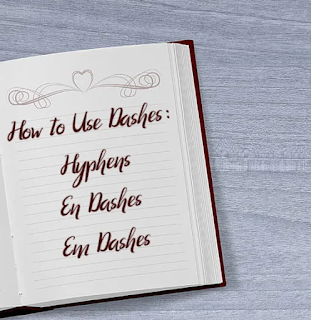
Note: This article was originally published July 7, 2020 on my now-defunct AMA Creative Solutions website. I have made only the most minor edits in cases of particularly obvious or obnoxious grammatical errors. There are three different dashes that each have their own purpose. Hyphens are used within words to show a specific meaning. The en dash is most often used in date ranges and point scores. The em dash is a stylistic punctuation mark that is used to reflect a pronounced pause or to highlight specific information. I will be explaining how each of these types of dashes is used in general writing. As always, if you are writing professionally, double-check your organization’s style guide. Hyphens Hyphens are placed within words to demonstrate specific meanings or to show that the word continues on the next line. They are entered into a word processor by pressing the dash key (most U.S. keyboards have it placed to the right of the number row) or the minus key on the number pad. You c...